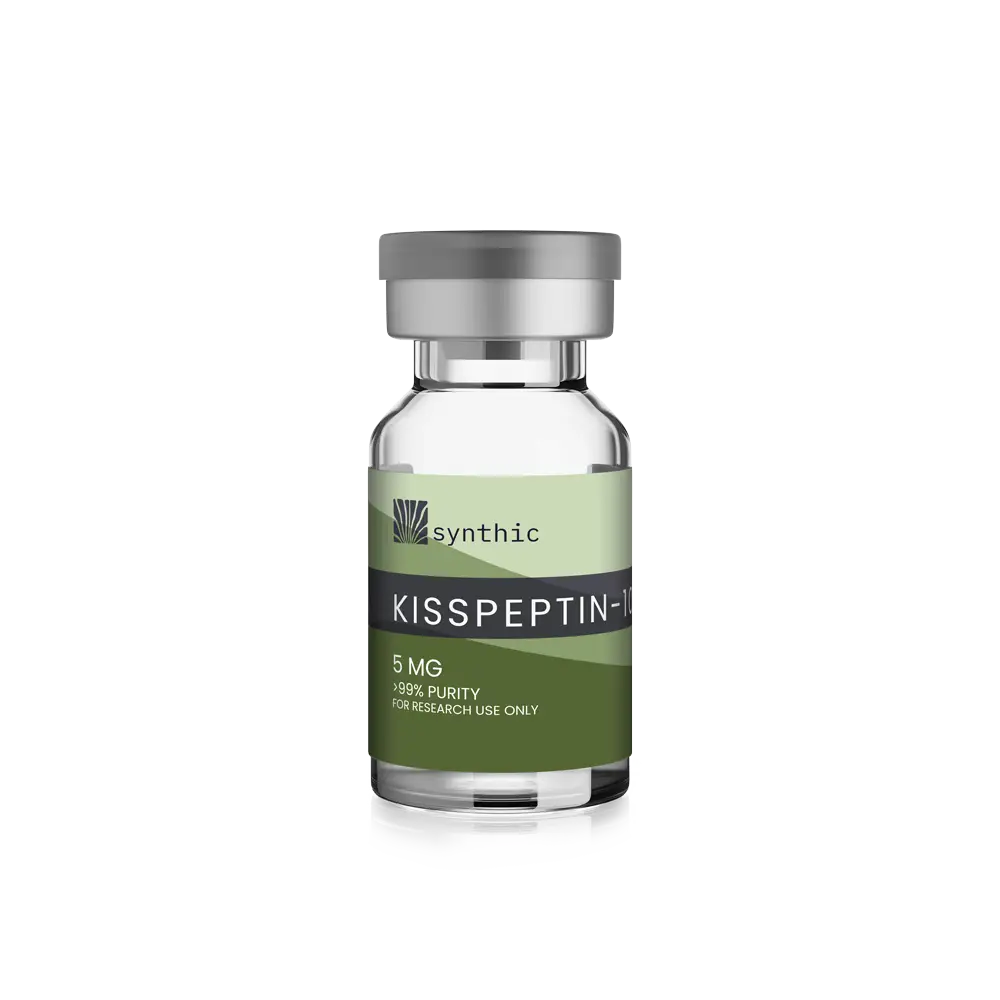

If you’ve spent any time researching hormones — testosterone, estrogen, LH — you’ve probably noticed that most of the conversation happens at the bottom of the chain. What gets released. What the numbers look like. What goes wrong downstream.
Kisspeptin-10 is different. It operates near the top of that chain, before any of those hormones are produced. That upstream position is exactly what makes it one of the more interesting peptides in reproductive and endocrine research right now.
What Kisspeptin-10 Actually Does
Kisspeptin-10 is a short peptide — just 10 amino acids — derived from a gene called KISS1. When it binds to its receptor (KISS1R) in the hypothalamus, it triggers the release of GnRH, the hormone that tells your pituitary to secrete LH and FSH.
That chain matters:
Kisspeptin-10 → GnRH → LH + FSH → Testosterone / Estrogen / Sperm / Eggs
Everything further down that list depends on the signal that starts at the top. Kisspeptin-10 is that signal. Without it — or when it’s suppressed — the entire reproductive axis goes quiet.
Who Is Researching Kisspeptin-10, and Why?
Testosterone and Male Hormone Recovery
Researchers studying testosterone deficiency and hormone suppression are particularly interested in KP-10’s upstream position. Unlike direct testosterone administration, which bypasses and suppresses the natural HPG axis, kisspeptin-10 works through the body’s own signaling pathway. It stimulates LH production — and LH is what drives the testes to produce testosterone endogenously.
This makes KP-10 a mechanistically distinct area of investigation compared to hormone replacement approaches. Rather than replacing a downstream hormone, it’s being studied as a way to understand and potentially restore the upstream signal that drives natural production. For researchers focused on post-suppression recovery, hypogonadotropic hypogonadism, or simply understanding what governs testosterone output, this is a meaningful distinction.
Female Fertility and Ovulation Research
In female reproductive research, kisspeptin-10 is studied for its role in triggering the LH surge — the signal that initiates ovulation. This is an area of active clinical investigation, particularly in the context of assisted reproduction. KP-10 has been examined as a potential trigger for final oocyte maturation, with the rationale that using an endogenous upstream signal may more closely mirror natural ovulatory physiology compared to synthetic alternatives.
Puberty and Reproductive Development
One of the earliest findings that put kisspeptin on the map: individuals with loss-of-function mutations in the KISS1R receptor consistently fail to enter puberty. Their GnRH pulses don’t initiate normally, and without that signal, LH and FSH stay low. This connection between kisspeptin signaling and pubertal onset has made KP-10 a valuable research tool for studying how the reproductive axis switches on — and what happens when it doesn’t.
Kisspeptin-10 and Libido: What the Research Shows
Low sexual desire — clinically termed hypoactive sexual desire disorder (HSDD) — affects an estimated 8% of men and up to 10% of women, and currently has very limited pharmacological treatment options. Kisspeptin-10 has emerged as one of the more compelling compounds being studied in this space, and the evidence so far goes beyond hormones alone.
Two randomized, double-blind, placebo-controlled clinical trials published in JAMA Network Open — one in 32 men, one in 32 premenopausal women, both with HSDD — used fMRI brain imaging alongside hormonal and behavioral assessments to study kisspeptin’s effects during sexual stimuli. The results were consistent across both sexes.
In men, kisspeptin administration significantly increased activity in brain regions associated with sexual desire and arousal, including the anterior cingulate cortex — a region involved in the motivational and autonomic components of sexual behavior. It also produced measurable increases in penile tumescence of up to 56% more than placebo, and participants reported improved behavioral measures of sexual desire, including increased happiness about sex.
In women, kisspeptin showed a similar pattern: enhanced brain activity in sexual arousal centers, and reduced activity in regions linked to self-monitoring and self-judgment — areas that, when overactive, are thought to inhibit desire. Participants reported feeling more sexually engaged after kisspeptin administration compared to placebo.
What makes these findings notable is the mechanism. Kisspeptin doesn’t appear to be acting purely through downstream hormone changes. KISS1R is expressed in brain regions involved in emotion, mood, and reward processing — meaning kisspeptin may influence sexual desire through direct central nervous system pathways, not just by raising testosterone or estrogen. This distinction matters: researchers studying men with normal testosterone levels who still experience low libido are paying particular attention to this.
The researchers behind the Imperial College London trials described the results as proof-of-concept for kisspeptin-based treatment in psychosexual disorders. Larger-scale studies, different delivery routes, and broader patient populations are the natural next steps.
Kisspeptin-10 and Metabolism: An Emerging Connection
The reproductive axis doesn’t operate in isolation. It’s directly influenced by metabolic status — a fact that’s been observed clinically for a long time. Athletes in severe caloric deficit lose menstrual cycles. Men with obesity or insulin resistance often show suppressed LH and testosterone. Kisspeptin neurons are part of how the body communicates that metabolic state to the reproductive axis.
Kisspeptin neurons express receptors for leptin and insulin. When energy availability drops sharply, kisspeptin signaling is suppressed, and GnRH pulsatility follows. The reproductive system essentially powers down when the body detects conditions unsuitable for reproduction.
What’s newer is the suggestion that this relationship may run in both directions. Mouse studies with KISS1R knockout models showed increased adiposity and reduced energy expenditure — raising the question of whether kisspeptin signaling influences fat tissue directly, not just indirectly via reproductive hormones. KISS1R expression has been identified in adipose tissue. This remains an early and investigational area, but it points toward a broader metabolic role that researchers are continuing to explore.
The Cancer Biology Connection
Kisspeptin-10 has a second, entirely separate research identity: it’s derived from a gene originally discovered as a metastasis suppressor.
In the 1990s, researchers found that restoring expression of chromosome 6 in metastatic melanoma cells suppressed their spread. The responsible gene was named KISS1. Since then, reduced or absent KISS1 expression has been documented in metastatic melanoma, certain breast cancers, and other solid tumors. Experimental models restoring KISS1 expression have shown suppressed metastatic dissemination — not primary tumor growth, specifically, but spread.
This is a distinct field from the endocrine research, but it’s part of why kisspeptin-10 carries broader scientific interest than a typical reproductive peptide. The same molecule that initiates puberty signaling is also being studied in oncology contexts.
Key Research Areas at a Glance
| Research Focus | What KP-10 Is Being Studied For |
|---|---|
| Testosterone / male hormones | Upstream LH stimulation; HPG axis recovery |
| Female fertility | Ovulation triggering; LH surge research |
| Libido and sexual desire | Brain-level modulation of sexual arousal and desire (HSDD) |
| Puberty disorders | Hypogonadotropic hypogonadism models |
| Metabolic health | Energy balance and adipose tissue signaling |
| Cancer biology | KISS1 metastasis suppression mechanisms |
Research Context
Kisspeptin-10 is a research compound. It is not approved for therapeutic use and is not intended for human administration outside of clinical research. All studies referenced here reflect investigational work — the science is substantive, but clinical applications remain in development.
What is established: kisspeptin-10 sits at a critical upstream position in the hormonal cascade that governs reproduction, puberty, and potentially metabolic function. That positioning — and the precision it offers researchers studying how that cascade initiates and fails — is why it continues to be a compound worth watching.