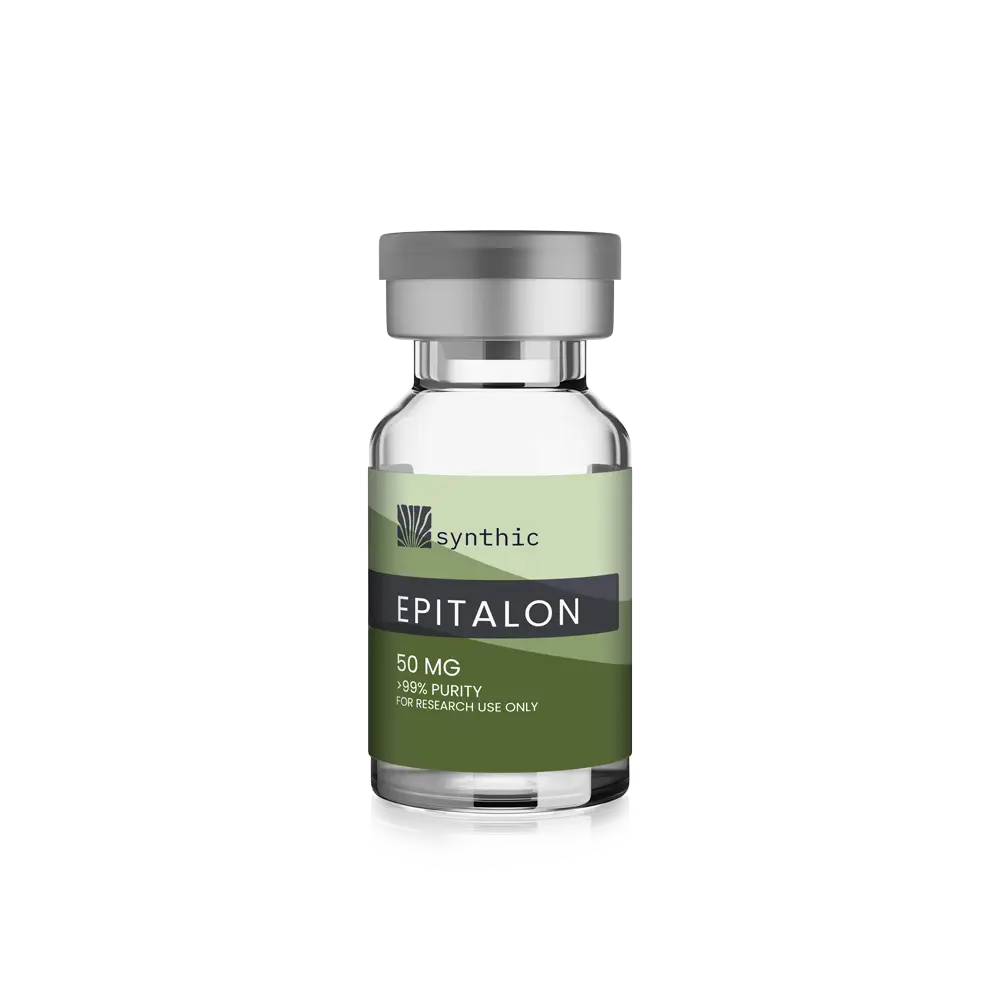

Every cell in your body has a built-in limit on how many times it can divide. That limit isn’t random — it’s written into the structure of your chromosomes. At the end of each one sits a protective cap called a telomere, and each time a cell copies itself, that cap gets a little shorter. When it runs out, the cell stops dividing. It ages, and eventually it dies.
This is one of the most well-documented mechanisms of biological aging. And it’s the reason a small, four-amino-acid peptide called Epithalon has attracted serious research attention.
A Tetrapeptide from the Pineal Gland
Epitalon was developed by Vladimir Khavinson and his team at the St. Petersburg Institute of Biogerontology — researchers who spent decades investigating whether small peptides could influence how cells age. The compound is a synthetic version of a natural peptide found in the pineal gland, the small structure in the brain best known for regulating melatonin and sleep cycles.
The sequence is simple: four amino acids — alanine, glutamic acid, aspartic acid, glycine. That simplicity is part of what makes it interesting to researchers. Small peptides are generally more stable, more predictable in how they behave, and easier to study than larger biological molecules.
What Khavinson’s research proposed is that this tiny compound might influence one of the core mechanisms driving cellular aging: the shortening of telomeres.
The Cellular Clock Problem
Think of telomeres like the plastic tips at the end of a shoelace. They protect the chromosome from fraying. Every time a cell divides, those tips get trimmed a little shorter. At some point, they’re too short to protect the chromosome properly — and the cell responds by shutting down its ability to replicate.
The enzyme responsible for rebuilding those tips is called telomerase. In most adult cells, telomerase is largely switched off. The body keeps it quiet for good reason: when telomerase runs unchecked, cells can divide indefinitely — which is exactly what happens in cancer. So the suppression is protective.
The research question around Epitalon is whether it can selectively nudge telomerase activity in normal, healthy cells — supporting chromosomal maintenance without triggering the kind of uncontrolled growth associated with disease.
What the Research Has Explored
Studies on Epitalon span several decades and cover a range of biological contexts.
Cell lifespan. Early laboratory work examined human cells treated with Epitalon. The research reported that treated cells continued dividing past the point where untreated cells would normally stop — suggesting a possible extension of replicative capacity. This work laid the foundation for subsequent research, though independent replication continues to be an area of active interest.
Oxidative stress. Aging isn’t driven by telomere shortening alone. Oxidative damage — the cellular wear and tear caused by unstable molecules called free radicals — runs in parallel. Research has examined whether Epitalon supports the enzymes cells use to neutralize this kind of damage. Less oxidative burden means less pressure on cells that are already managing the effects of shortening telomeres.
The pineal connection. Because Epitalon originates from pineal tissue, researchers have also looked at its relationship to melatonin production. Melatonin output tends to decline with age, affecting sleep quality and circadian regulation. Some research suggests Epitalon may support pineal function in older organisms, adding a circadian dimension to its potential effects that goes beyond direct telomere biology.
Lifespan studies. Animal studies — in rodents and simpler model organisms — have examined survival outcomes in cohorts treated with Epitalon. Results have varied depending on the model and protocol, but some studies reported improved survival metrics in treated groups. These findings are preliminary and shouldn’t be directly extrapolated to humans, but they’ve been enough to sustain ongoing research interest.
The cancer question. It’s a fair question to ask: if Epitalon activates telomerase, does it raise cancer risk? Research to date hasn’t demonstrated pro-tumorigenic effects at studied doses — and some work has actually examined potential anti-tumor properties. The relationship between Epitalon and cellular proliferation appears more nuanced than simple telomerase switching. That said, this remains one of the more important open questions in the literature.
How This Connects to NAD⁺
Telomere biology and cellular energy aren’t separate topics — they’re linked in ways that only became clear relatively recently.
When telomeres get short or damaged, they trigger DNA repair processes inside the cell. Those repair processes consume NAD⁺ — a coenzyme that powers hundreds of metabolic functions, from energy production to cellular maintenance. As covered in the NAD⁺: The Missing Piece article, NAD⁺ levels naturally decline with age. When telomere stress chronically activates DNA repair, it accelerates that depletion.
The result is a feedback loop: shortening telomeres drive more repair activity, which drains NAD⁺, which leaves cells less equipped to handle the next round of damage. Research interest in combining telomere-focused compounds like Epitalon with NAD⁺ support is grounded in this connection. They’re not doing the same job — they’re supporting different parts of the same system.
Where Epitalon Fits
The longevity research space has grown considerably. MOTS-c addresses how mitochondria handle energy and metabolic stress. NAD⁺ supports the coenzyme infrastructure that underlies cellular repair. SS-31 targets the structural integrity of the mitochondrial membrane. Each of these works on a different axis.
Epitalon’s focus is the chromosome itself — maintaining the structural integrity of DNA across cell divisions over time. That makes it a distinct addition to longevity-focused research rather than a replacement for any of the compounds already in that conversation.
What sets Epitalon apart from many newer compounds is the depth of research behind it. Decades of work — primarily from Eastern European institutions — have examined it across multiple biological contexts. That literature doesn’t represent settled consensus, and much of it hasn’t been replicated in Western research settings. But it represents a serious, sustained body of scientific inquiry that’s hard to dismiss.
For researchers interested in the biology of aging at the chromosomal level, Epitalon remains one of the more compelling subjects in the current literature.